








A European-built platform enters North America with $129B in managed spend, a track record of $16B in verified savings, and a message that most organizations are still treating procurement far too late in the investment cycle.
There is a line that Natalie Eksi, CEO and Co-Founder of APSentra, returns to often when she talks about how organizations make financial decisions. “Business and gambling are very close,” she says. “In gambling, you hope. In business, you control. And if you cannot control your investment, if you cannot control your budgets and procurement, it’s not business — it’s gambling.”
It is a deliberately sharp way of framing what might otherwise sound like an operational debate. But Eksi’s point cuts to something real. A LinkedIn poll conducted by APSentra ahead of one of its recent industry sessions found that only 44 percent of organizations involve procurement before a major investment decision is made. Another 25 percent bring procurement in only after the budget has already been set. Nineteen percent engage procurement only at final sign-off. And 13 percent call in procurement only after the fact.
That means in more than half of investment decisions, procurement — the function responsible for translating strategic intent into contracted, delivered, and measurable value — is not at the table when it matters.
For Adam Besson, Chief Executive Officer at FlexChain and President of the Supply Chain Management Professionals South Florida Roundtable, the finding reflects a divide that runs deeper than process design. “Some organizations really have this concept of strategic procurement — thinking of it as core to their strategy for sustaining the business,” he says. “And other businesses have a very different view: procurement is just something you do. You figure out the supplier once you’ve figured out everything else.”
Sajidul Mawla, CEO at NTAC Consulting and Professor of Supply Chain at George Brown Polytechnic, frames the consequence plainly: “The fifty-six percent who engage procurement too late — the consequences are cost overrun and schedule delay. That shows a maturity gap, and those organizations need to work on both procurement strategy and procurement operations.”
The Trillion-Dollar Gap
The gap between where procurement sits today and where it should sit is not a theoretical problem. A McKinsey analysis cited during APSentra’s “Behind Procurement” series estimated that better contracting and capital procurement practices in large project delivery have the potential to capture cost improvements of five to fifteen percent. Applied to North America’s construction market alone — which runs at roughly three trillion dollars annually — that translates to between $150 billion and $450 billion in accessible savings.
“That’s the GDP of a mid-sized country,” Mawla observes. “And it’s sitting on the table because procurement is not structured, not standardized, and not optimized. I call it SSO. When any one of those three is missing, you see failures in major projects — wrong supplier selection, cost overrun, schedule delay.”
The same principle applies beyond capital investment. In operational spending, in technology procurement, in professional services, in every category where an organization commits money before it receives value, the absence of procurement discipline compounds over time. Fragmented approval processes, contracts living in email inboxes, supplier data spread across spreadsheets, no unified view of what has been committed versus what has been delivered — these are not edge cases. They are, according to APSentra’s client data, the norm in organizations that have not deliberately built procurement governance into their operations.
APSentra’s Answer: Control Built into the Workflow
APSentra was founded on a specific belief: that procurement governance should not be a layer added on top of operations, but a property of the system through which operations run. The platform delivers this through what it describes as a digital twin of the organizational structure — a model of every approval route, budget line, authority level, and supplier pool that mirrors how the business actually works.
When a purchase request is raised inside APSentra, the system already knows which budget it draws from, who must approve it, and which supplier pool it should route to. There is no separate step in which someone manually checks whether the request has authorization or whether the budget exists. That logic is embedded in the workflow itself.
The result is what APSentra calls a single source of truth: one connected, auditable record of every procurement decision, contract, commitment, and delivery across the organization, accessible at any time by procurement teams, finance functions, and executive leadership alike.
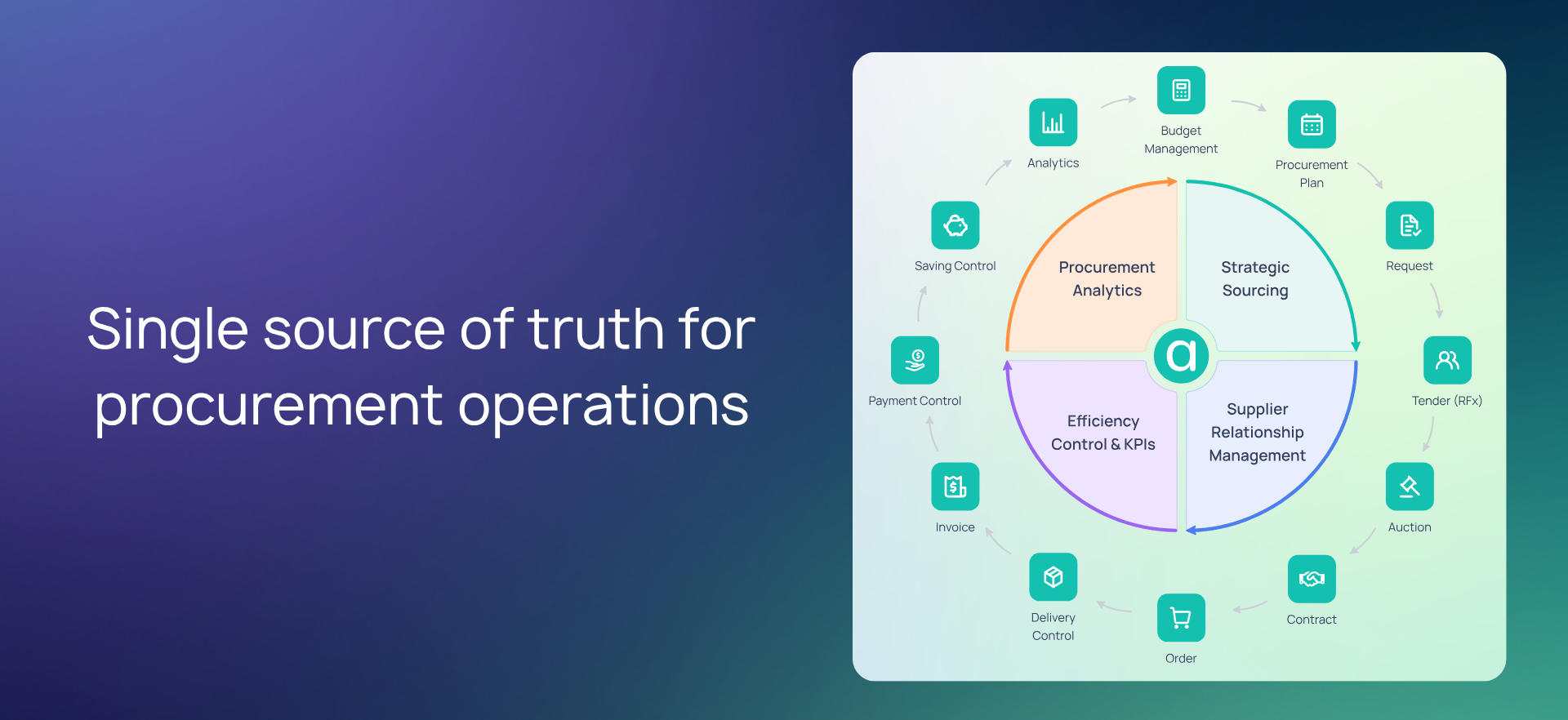
The platform covers the entire source-to-pay cycle in one environment: procurement planning with real-time budget validation; structured request intake with multi-level approval routing; tender and auction management with standardized supplier selection; digital contract creation and lifecycle management; order placement and delivery tracking with real-time verification against contracted volumes; and consolidated analytics across all regions and business units.
What AI Actually Does Here
Procurement technology platforms frequently invoke artificial intelligence. APSentra’s application of it is deliberately specific. The platform does not use AI to simply automate manual steps — it uses it to study the data that a unified procurement environment produces, surface anomalies that would otherwise be invisible, model spend patterns, and improve the quality of decisions before commitments are made.
The distinction matters, and it comes with a prerequisite. Sharon Custer, Founder of Inventory Optimization Pro, addressed it directly during one of APSentra’s webinar sessions: “If it’s garbage in, it’s garbage out. With AI, building a clean and trusted data foundation is more achievable than ever — but it requires the willingness to confront the underlying mess first.”
APSentra’s own polling across its professional community identified poor data quality as the leading reason procurement AI initiatives fail, ahead of fragmented workflows and insufficient cross-functional alignment. That finding shapes how the platform approaches implementation. Maurizio Dizan, VP of Professional Services and Customer Success at EBS SoundTrack, describes it as a discipline that must come before any integration work begins: “This is the ‘don’t touch the keyboard’ stage. Before any integration begins, organizations need to map processes, align stakeholders, and understand their data structure. AI transformation is not plug-and-play — but when done properly, the results are powerful.”
A Case Study in What Unified Procurement Delivers
APSentra’s client portfolio spans financial services, telecommunications, logistics, energy, and infrastructure. One case study the company has made public involves a large industrial group — an organization with multiple operating companies investing across manufacturing, infrastructure, and development — that came to APSentra with fragmented procurement processes, separated from operations, supply chain, and finance departments, with different workflows running inside each entity in the group.
The challenge was not unique. As Besson notes, when every team defines and measures procurement differently — where one business unit counts direct savings, another counts cost mitigation, and a third has no consistent method at all — the information that flows up to leadership is unreliable as a basis for investment decisions, portfolio management, or capital allocation.
What APSentra provided was a unified procurement framework across all of the group’s business units, with standardized processes, shared governance, and a single operational record spanning the entire organization. The outcomes included end-to-end supplier traceability, significantly improved onboarding efficiency, and — critically — the ability for leadership to assess procurement performance with confidence rather than reconciliation.
“The goal when a company is running its balance sheet — whether to raise funds, make an acquisition, or sell an existing company within a portfolio — is that it all has to be built on sound financials,” Besson explains. “If every different team has its own process for self-appraising, it becomes very difficult to do that accurately.”
Entering North America
APSentra enters the North American market with a profile that enterprise buyers in the US and Canada will find unusual at this stage of market entry: more than 130 enterprise clients already live on the platform, more than two million procurement requests processed, more than 386,000 tenders managed, approximately $16 billion in verified savings delivered, and a customer satisfaction rate above 94 percent.
The company’s corporate office is headquartered in Mississauga, Ontario, with the platform available immediately to US and Canadian organizations. Implementation follows a five-stage structured process — consulting, implementation and automation, integration, learning, and ongoing control and optimization — with a typical timeline of up to eight weeks for a platform of this scope.
APSentra positions itself explicitly as an alternative to the dominant pattern in enterprise procurement technology, where organizations layer point solutions across the source-to-pay cycle and spend significant effort reconciling them. The platform is ERP-agnostic and integrates with existing accounting and enterprise resource planning environments, including bidirectional SAP integration, so adoption does not require a wholesale replacement of existing systems.
“Behind Procurement”: A Knowledge Platform for the Industry
Alongside its North American expansion, APSentra has launched “Behind Procurement,” a biweekly live webinar series hosted by Eksi and designed to deliver practical, experience-based insight to procurement and supply chain professionals worldwide.
The series covers market trends, applied research, case studies, and expert perspectives on procurement strategy, financial performance, and technology-enabled transformation. Its underlying aim, consistent with APSentra’s platform positioning, is to reframe procurement not as a purchasing department but as a strategic driver of enterprise value — a function that, when properly structured, protects investment returns, improves financial transparency, and directly supports business performance.
“Procurement influences the majority of enterprise spending,” Eksi says. “It should be positioned as a core financial function, not a purely operational one. The organizations that understand that are the ones running a business. The ones that don’t are, at some level, still gambling.”
Sessions air every second Thursday at 10 a.m. EST. Upcoming episodes and participation details are available through APSentra’s platform and via Eksi’s LinkedIn profile.
APSentra is a global source-to-pay procurement platform headquartered at 131 Robert Speck Parkway, Mississauga, ON L4Z 0A6, Canada. Further information is available at apsentra.com.